

Navigating the System: Your Guide to Pretrial Release Options
Pretrial Release Options: Top 6 Expert Tips for Success

Pretrial release options are crucial in balancing the scales of justice, ensuring both due process for defendants and the safety of our communities. Before a trial even begins, decisions surrounding a defendant’s freedom can have lasting impacts on their life and our society.
Here’s a quick look at the key options:
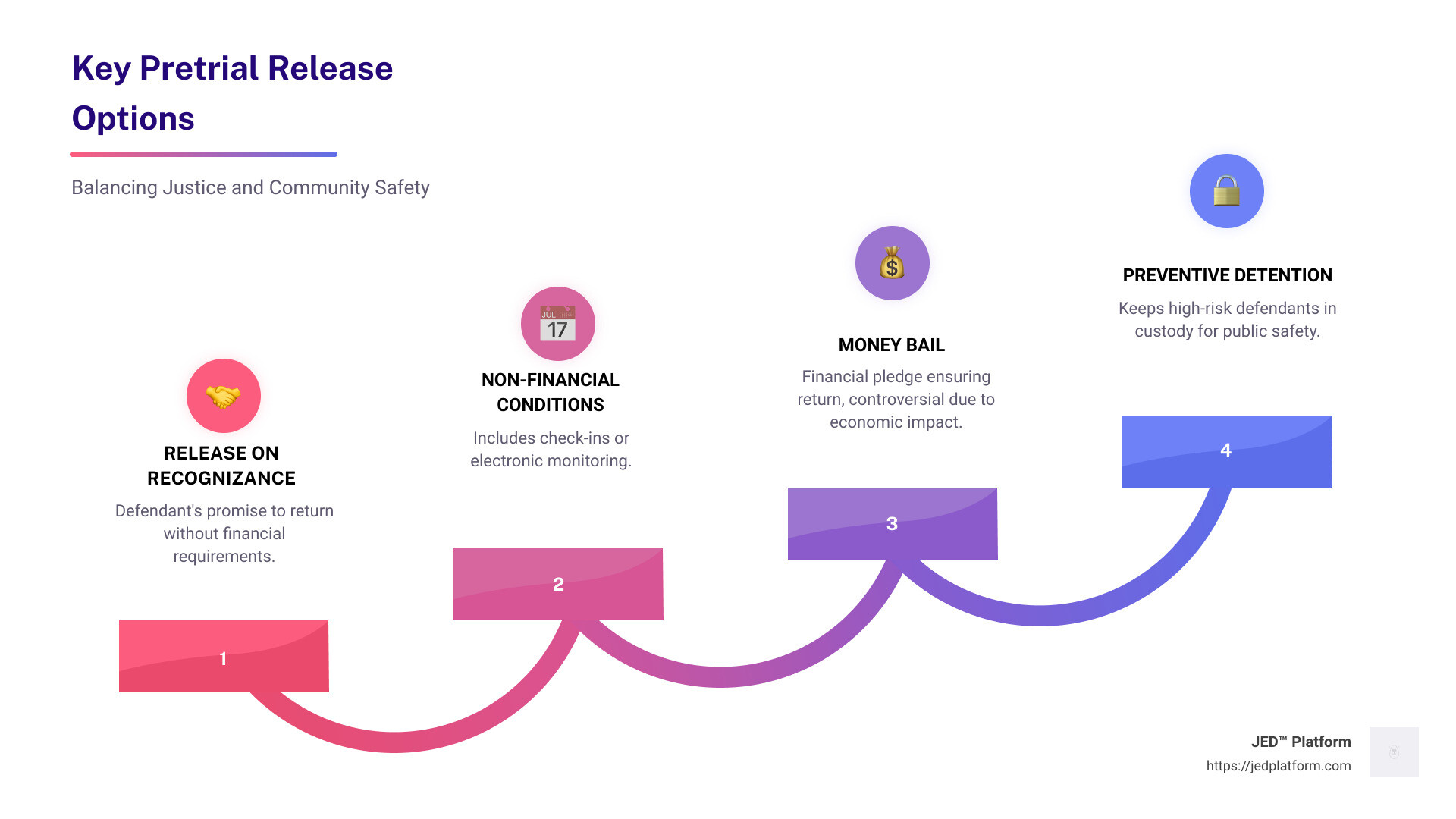
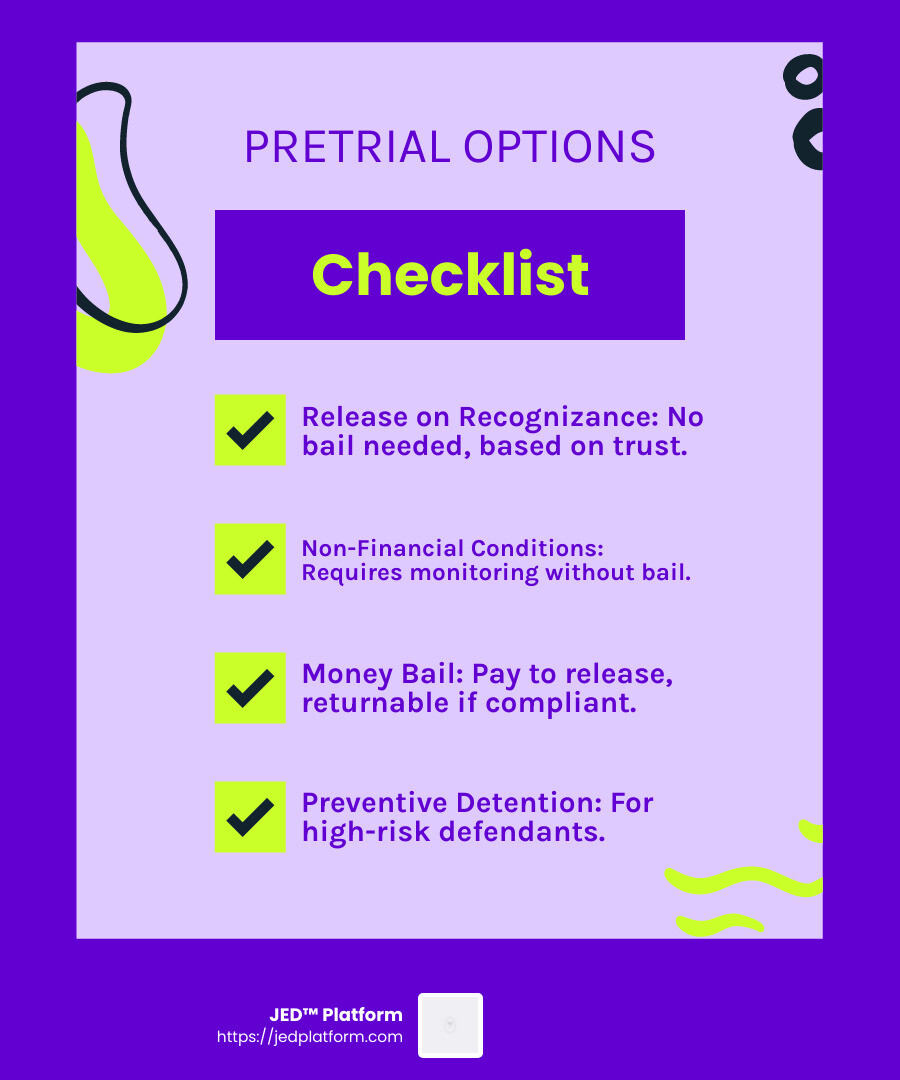
- Release on personal recognizance: The defendant promises to return for trial without any financial requirements.
- Release with non-financial conditions: This might include regular check-ins or electronic monitoring.
- Money bail: A financial pledge paid to secure release, which is a contested option due to its impact on economically disadvantaged defendants.
- Preventive detention: Keeps the defendant in custody if they’re deemed a high risk to public safety.
Understanding these choices helps ensure fair treatment and community protection. The American Bar Association emphasizes choosing the least restrictive option, promoting a justice system that is fair yet firm.
Understanding Pretrial Release Options
Navigating the pretrial landscape can be tricky. Let’s break down the pretrial release options to understand each one better.
Release on Recognizance
Release on recognizance (ROR) is like a pinky promise to the court. The defendant agrees to show up for their court dates without needing to pay bail. It’s often granted when the charges are minor, and the defendant has a clean record. Most states authorize this option, as it supports the idea that not everyone needs to be locked up before their trial. It’s a simple way to keep low-risk individuals out of jail.
Non-Financial Conditions
Sometimes, a judge might set non-financial conditions for pretrial release. These are extra rules the defendant must follow, like attending regular check-ins with a pretrial services officer or wearing an electronic monitor. These conditions help ensure the defendant behaves and shows up for court, without the burden of paying bail. It’s an approach that balances freedom with responsibility.
Money Bail
Money bail is a bit like a security deposit. The defendant pays a set amount to the court to get out of jail. If they attend all their court dates, they get the money back. But if they skip town, the court keeps it. This system has been criticized for being unfair to low-income defendants who can’t afford bail. They end up staying in jail, even if they’re not a flight risk or dangerous.
Preventive Detention
Preventive detention is when the court decides to keep a defendant in custody because they might be a danger to the community or a flight risk. This is the most restrictive option and is used sparingly. The goal is to protect the public and ensure the defendant appears in court. It’s a tough call, balancing public safety with individual rights.
Each of these pretrial release options serves a purpose in the justice system. By understanding them, we can promote a fairer process that respects both individual rights and community safety.
Next, we’ll explore how risk assessments play a role in these decisions, helping judges make informed choices about pretrial release.
The Role of Risk Assessment in Pretrial Decisions
Risk assessments are essential tools in the pretrial process. They help judges make informed decisions about whether a defendant should be released before trial and under what conditions. These assessments focus on two main factors: flight risk and public safety.
Understanding Risk Assessment
Risk assessments use data to predict the likelihood of a defendant not showing up for court (flight risk) or committing another crime while awaiting trial. They consider various factors, including:
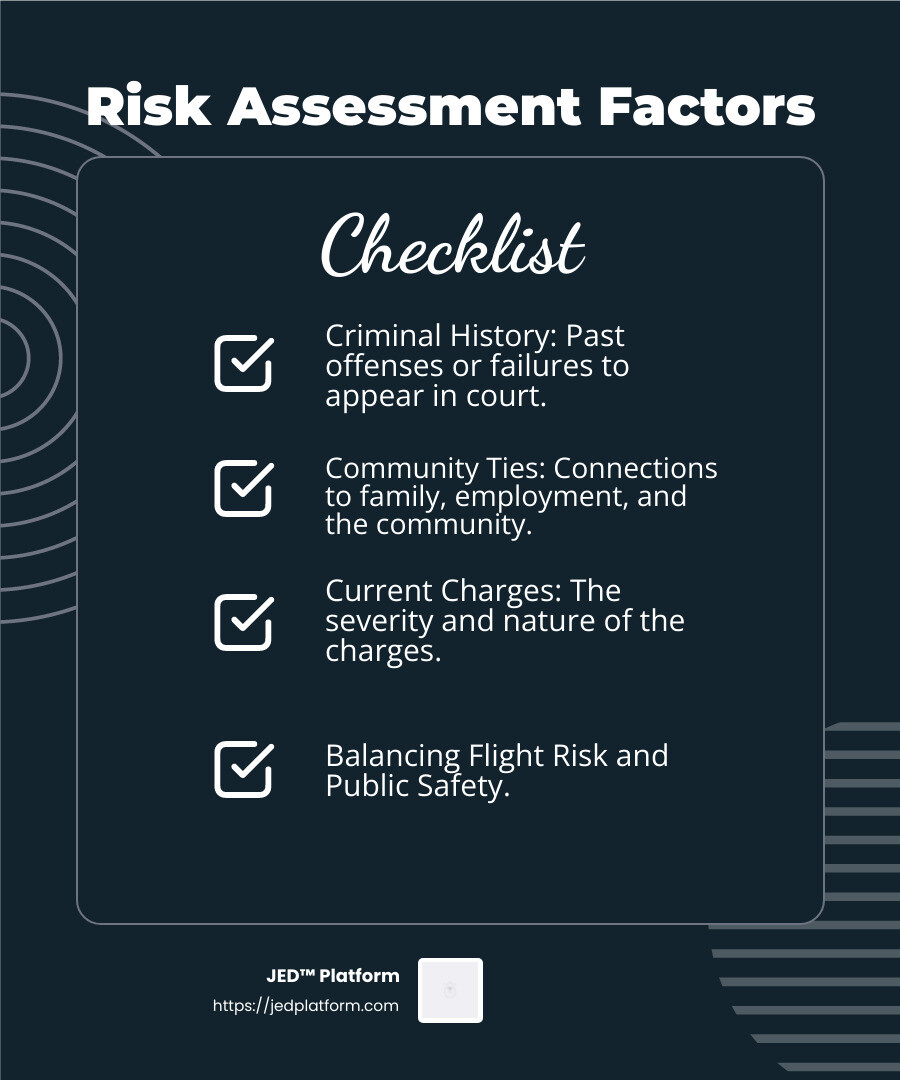
- Criminal History: Past offenses or failures to appear in court.
- Community Ties: Connections to family, employment, and the community.
- Current Charges: The severity and nature of the charges.
These evaluations aim to provide a fair analysis, ensuring that decisions aren’t based solely on intuition or bias.
Balancing Flight Risk and Public Safety
Flight risk is a major concern in pretrial decisions. Courts need assurance that defendants will attend their court dates. Risk assessments help identify individuals who are less likely to flee, allowing for more lenient release options, like release on recognizance or non-financial conditions.
Public safety is another critical factor. Judges need to ensure that releasing a defendant won’t pose a threat to the community. Risk assessments help identify those who might be a danger, guiding the decision toward more restrictive measures, like preventive detention.
Evidence-Based Decisions
Research supports the use of risk assessments in pretrial decisions. According to the Conference of Chief Justices, these tools help balance defendants’ rights with community safety. They recommend the presumptive use of non-financial release conditions as the best approach.
By relying on evidence-based assessments, judges can make more consistent and fair decisions. This reduces the chance of economically disadvantaged defendants remaining in jail simply because they can’t afford bail.
In the next section, we’ll dive into the concept of least restrictive alternatives and how they play a crucial role in ensuring fairness in pretrial release.
Least Restrictive Alternatives in Pretrial Release
When considering pretrial release options, the goal is to choose the least restrictive method that ensures both the defendant’s appearance in court and community safety. This approach respects the defendant’s right to liberty while balancing public concerns.
Community Monitoring
Community monitoring is a popular option that allows defendants to remain in their communities under supervision. This can include regular check-ins with pretrial services, curfews, or participation in specific programs. The idea is to maintain some level of oversight without unnecessary confinement.
- Benefits: Keeps defendants integrated in their communities, allowing them to maintain jobs and family responsibilities.
- Challenges: Requires resources for monitoring and might not be suitable for high-risk individuals.
Electronic Monitoring
Electronic monitoring is another method used to keep track of defendants. This often involves wearing an ankle bracelet that tracks their location. It’s a step up from basic community monitoring but still less restrictive than jail.
- Advantages: Provides real-time location data, ensuring defendants remain within allowed areas.
- Limitations: Can be costly and might raise privacy concerns.
Balancing Freedom and Safety
The key to pretrial release is finding the balance between freedom and safety. Using the least restrictive means possible helps prevent the negative impacts of unnecessary detention, such as job loss or family disruption. According to the American Bar Association, the default decision should be release pending trial, with restrictions applied only as needed.
By focusing on community-based options like monitoring and electronic tracking, courts can uphold justice without resorting to excessive confinement. This approach not only benefits defendants but also reduces the burden on the judicial system.
Next, we’ll explore how financial conditions impact pretrial release and the challenges they pose for economically disadvantaged individuals.
Financial Conditions and Their Impact
When it comes to pretrial release options, financial conditions play a significant role. These conditions can include cash bail, surety bonds, and property bonds. While these methods aim to ensure a defendant’s appearance in court, they often raise concerns about fairness and economic disadvantage.
Cash Bail
Cash bail is a common method where defendants pay a set amount of money to secure their release. If they attend all court proceedings, the money is returned. However, if they fail to appear, they forfeit the money.
- Pros: Provides a financial incentive for defendants to return to court.
- Cons: Can be a heavy burden for those without financial means, leading to unnecessary detention of low-risk individuals.
Economic Disadvantage
The reliance on cash bail disproportionately affects those with limited financial resources. Many defendants cannot afford even small bail amounts, resulting in prolonged pretrial detention. This can lead to job loss, family strain, and other negative consequences.
According to the JED™ Platform, jurisdictions that use cash bail systems often see higher rates of pretrial detention among economically disadvantaged individuals. This raises questions about equality and justice in the legal system.
Alternative Financial Conditions
To address these concerns, some jurisdictions are moving away from strict cash bail requirements. Instead, they are exploring alternatives like:
- Deposit Bonds: Defendants pay a percentage of the total bail amount, making it more affordable.
- Uncompensated Surety Bonds: Family or friends can pledge to ensure the defendant’s court appearance without profit.
- Property Bonds: Defendants use property as collateral instead of cash.
These alternatives aim to reduce the economic burden on defendants while still ensuring they return to court.
The Bigger Picture
Financial conditions in pretrial release highlight broader issues of equity and access to justice. By re-evaluating the role of money in these decisions, courts can work towards a system that is fairer for all individuals, regardless of their economic status.
In the next section, we’ll address frequently asked questions about pretrial release options, including common methods of securing release and potential disadvantages.
Frequently Asked Questions about Pretrial Release Options
What is the most common way to secure pretrial release?
The most common way to secure pretrial release is through release on recognizance (ROR). This means the court trusts the defendant to return for court proceedings without requiring them to pay bail. Court-ordered conditions may still apply, such as attending all hearings or avoiding contact with certain people.
ROR is often granted to individuals considered low risk, with strong community ties, or those facing less severe charges. It’s a way to keep people out of jail while they await trial, without the financial burden of bail.
What are the disadvantages of pretrial release?
While pretrial release can be beneficial, there are some potential downsides:
-
Non-appearance risk: There’s a chance the defendant might not show up for court dates. This is a risk courts consider when deciding on pretrial release options.
-
Active criminal justice status: Defendants on pretrial release are still involved in the legal system. If they violate any conditions, they risk being detained again.
-
Court-ordered conditions: These can be strict and sometimes difficult to follow, especially if they include electronic monitoring or frequent check-ins.
These challenges highlight the balance courts must strike between public safety and the rights of the defendant.
How long can you be on pretrial release?
The pretrial duration can vary widely. It depends on the complexity of the case and the court’s schedule. Some cases resolve quickly, while others may take months or even years.
During this time, defendants must adhere to all court-ordered conditions. The goal is to ensure they appear for all court proceedings and do not engage in any new criminal activity.
Understanding these aspects of pretrial release is crucial for navigating the legal system effectively. In the next section, we’ll explore the conclusion and how the JED™ Platform supports fair risk assessments and pretrial diversion programs.
Conclusion
Navigating the pretrial release process can be daunting, but that’s where we at JED™ Platform come in. Our mission is to simplify this journey by offering effective pretrial diversion programs that prioritize fairness and community safety.
Our approach is built on fair risk assessments. We believe every individual deserves a chance to demonstrate their reliability without unnecessary financial burdens. By using evidence-based methods, we ensure that release decisions are made with a clear understanding of each defendant’s unique situation. This means considering factors like flight risk and potential threats to public safety, all while respecting their rights to due process.
JED™ Platform is committed to reducing the negative impacts of pretrial detention. Our programs provide monitoring services that help individuals comply with court-ordered conditions, ensuring they appear for all necessary court proceedings. This not only supports defendants but also improves community trust and safety.
In conclusion, JED™ Platform is here to make the pretrial process smoother and more equitable for everyone involved. By focusing on fair assessments and supportive diversion programs, we aim to create a system where justice is accessible and balanced.